
Purpose
This document explains the feature of Running authenticated scan on found default credentials.
Introduction
The scanner checks for any available default credentials on various services from a list of different vendors, by performing logins to respective service and saves the credentials if successful. This complementary scan only run against SSH and SMB services.
Complementary Authenticated Scan
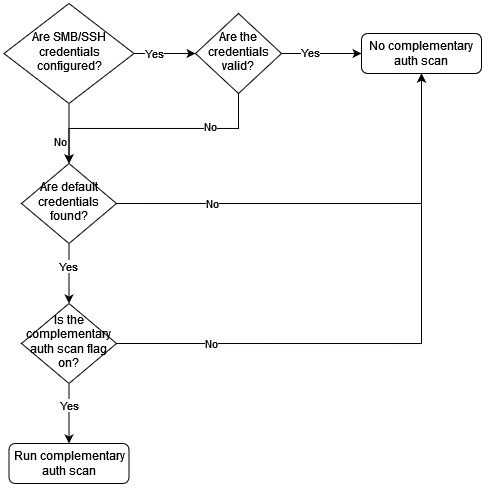
The Complementary Authenticated Scan performs a limited scoped SSH/SMB authenticated scan, and the default credentials that are found by harass are used for this scan. For an SSH authenticated scan, ssh-commands scanning components are used and for the SMB authenticated scan, psh-commands and remote-registry scanning components are used. There might be multiple default credentials configured on a target, in that case, complementary authenticated scan is performed only once with the credentials set from the top of the list.
Scope of Scan
Use case
The Complementary Authenticated Scan originated from a PCI scan where the target had an SSH service running on the default SSH port with default credentials from the vendor. The target was using the default credentials from the vendor <vendor:vendor> as username:password. No other port was present that was giving any useful information about the target. A PCI scan is originally an unauthenticated scan, and the scanner was unable to deduce what kind the target was. The only port that was present that could give some info about the target was the SSH port.
Scope
Taking this use case into consideration, an idea was formed to perform a limited scoped authenticated scan to determine the kind of Operating system and its version.
The scope of the implementation was increased from SSH to SMB as well. In conclusion, this feature involves in detecting the operating system version of the target by SSH and/or SMB authentication methods using the found default credentials.
Controllability of the Scan
Case-1
In the scan configuration, if the Disable logins checkbox is checked, then complementary authenticated scan will not run.
Case-2
If the scan has already been configured with working/valid credentials (in the sense an authenticated scan), then complementary authenticated scan will not run.
Case-3
If there is no default credentials found, then the complementary authenticated scan will not run.
Related Articles
- Windows 10/Windows 2019 Server
- Windows 8.1
- How to Test SMB Authentication
- Windows 2016 Server
- Core Installation
- Windows 2008 R2 Server
- SMB Authentication from OUTSCAN/HIAB
- Supported Platforms for Authenticated SSH Scanning
- Windows 7
- Authenticated Scanning Using SSH
- Troubleshooting SMB Authentication
- Windows 2012 R2 Server
- O24AUTH
- Complementary Authenticated Scan on Default Credentials
- Authenticated Scanning Using SMB